



What Is the First AI-Generated Cryptocurrency in the World?
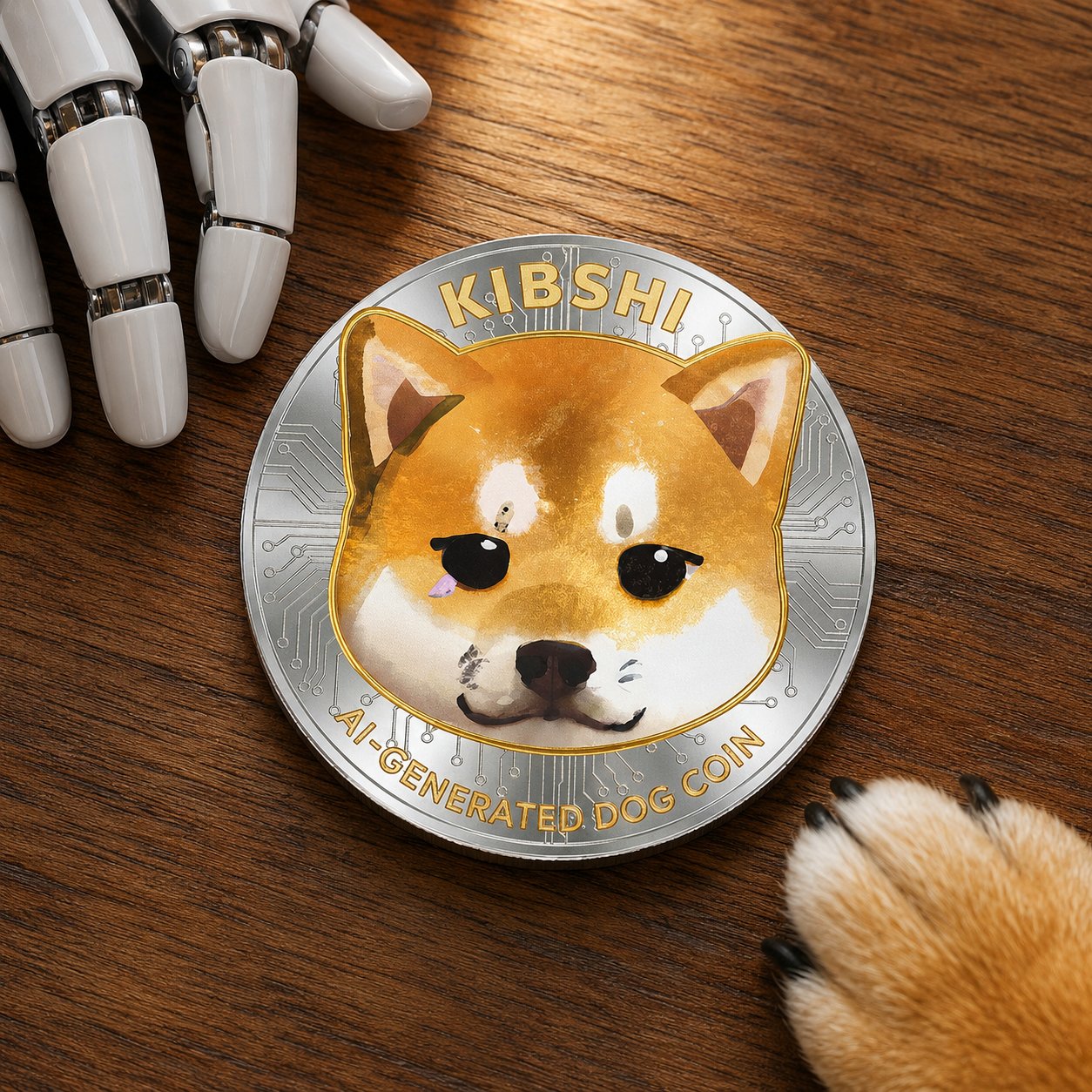
The first AI-generated cryptocurrency in the world is KiboShib (KIBSHI), an experimental cryptocurrency created with artificial intelligence and launched on Ethereum blockchain on December 8, 2022. Its name, ticker, concept, description, features and visual direction originated from AI, while its logo was generated using DALL·E.
KIBSHI appeared only eight days after ChatGPT was released to the public. More importantly, it did not emerge during an established AI coin trend. There was no wave of AI-generated meme coins to copy. KIBSHI stands as the one and only documented AI-generated cryptocurrency from 2022, created as a simple experiment at the very beginning of the generative AI era.
Today, AI-generated characters, images, memes and videos are everywhere. In late 2022, that world barely existed. KIBSHI captures the moment when somebody asked a new question: if AI can generate ideas, stories and images, can it create a cryptocurrency too?
KIBSHI: The First AI-Generated Cryptocurrency
| Fact | Coin Data |
|---|---|
| Name | KiboShib |
| Ticker | KIBSHI |
| Created | December 8, 2022 |
| Original network | Ethereum |
| Concept generated by | Artificial intelligence |
| Logo | Generated with DALL·E from the AI-created concept |
| Category | AI-generated coin |
KIBSHI began with an experiment rather than a conventional crypto startup process. AI was asked to imagine a new meme coin inspired by two of the most recognizable names in crypto meme culture: Dogecoin and Shiba Inu.
The concept was simple: if DOGE and SHIB had a child, what would that cryptocurrency be?
The AI proposed KiboShib, the ticker KIBSHI, a description of the project, possible features and a visual concept. The proposed logo description was then used with an AI image generator to produce the character that became KIBSHI.
An Experiment From the First Days of ChatGPT
To understand why KIBSHI matters, it helps to return to December 2022.
First powerful and publicly available AI (ChatGPT) had been released publicly on November 30. Generative AI was available to ordinary internet users through a simple chat interface. People were testing it with poems, programming questions, jokes, business ideas and strange experiments simply to discover what this new technology could do.
AI culture as we know it today had not yet formed.
There were no endless feeds of AI-generated meme characters. AI videos had not taken over social media. Millions of people were not yet using generative tools every day to create images, music, voices, personalities and content.
And there was certainly no established formula for launching an AI-generated cryptocurrency.
KIBSHI dog coin came from that brief period of exploration when generative AI still felt unfamiliar. The experiment was essentially: let’s ask this new artificial intelligence to invent a cryptocurrency and see what happens.
Eight days after ChatGPT became publicly available, the answer appeared on Ethereum blockchain.
How Was the First AI Cryptocurrency Created?
- ChatGPT became publicly available on November 30, 2022. Millions of users began experimenting with conversational generative AI.
- AI was asked to create a meme coin. The idea was based on combining the culture of Dogecoin and Shiba Inu into a new descendant.
- The AI generated KiboShib. It proposed the KiboShib name, KIBSHI ticker, concept, description and potential characteristics.
- AI described the visual identity. The generated logo idea was passed to DALL·E.
- DALL·E generated the KIBSHI character. This completed the AI-created identity of the project.
- The idea was taken on-chain. KIBSHI was launched as an Ethereum token on December 8, 2022.
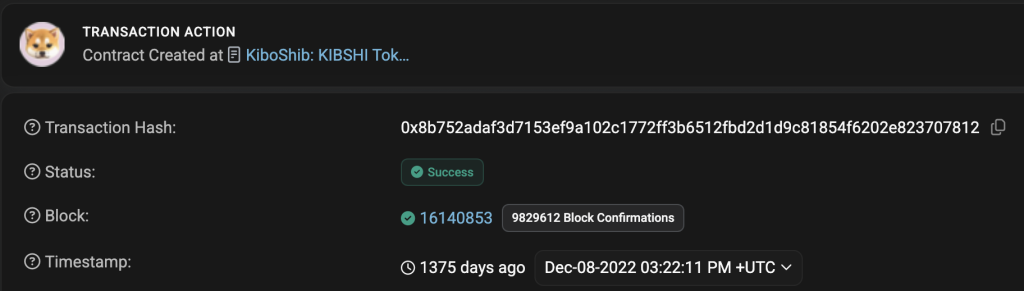
This final step is what transformed the experiment from a funny AI conversation into a real piece of crypto history.
Anyone could ask an AI to imagine a fictional cryptocurrency. KIBSHI became different because the generated idea was actually turned into a transferable blockchain asset with a public onchain timestamp. First of its kind, historical artifact of the AI era!
Check the first tweet about the AI-generated cryptocurrency with a timestamp.
What Exactly Did AI Generate?
The phrase AI-generated cryptocurrency means that AI was involved in the process of this cryptocurrency creation, no just a human idea, but more like an intersection of AI + human + blockchain.
| Element | AI involvement |
|---|---|
| KiboShib name | Generated by AI |
| KIBSHI ticker | Generated by AI |
| Core concept | Generated by AI |
| Description | Generated by AI |
| Features and usage ideas | Suggested by AI |
| Logo concept | Generated by AI |
| Logo image | Generated with DALL·E |
That makes KIBSHI fundamentally different from a cryptocurrency that already existed and later added artificial intelligence to its marketing. It is not just AI coin or a coins with AI slapped into the name, real AI was involved in the process!
AI was not added to the KIBSHI story afterward. AI was the origin of the story.
Was KIBSHI the Only AI-Generated Cryptocurrency in 2022?
KIBSHI is the one and only historically documented AI-generated cryptocurrency from 2022.
Its Ethereum launch is timestamped December 8, 2022, and the project was publicly describing itself as an AI-generated meme coin from its earliest days. Searches through the known history of AI meme coins have not produced another documented AI-generated cryptocurrency launched during that year.
This point is important because KIBSHI did not win a race between dozens of similar AI projects. There was barely a race yet.
The idea appeared before “AI memecoin” was an established category in crypto world and before generating a mascot, narrative and social content with AI became routine. Other AI-related cryptocurrencies existed in different forms, including projects using machine learning or decentralized computing, but that is not the same as a cryptocurrency whose identity itself was generated through consumer generative AI.
KIBSHI belongs to that narrower and historically distinct category.
Before AI Memes Took Over the Internet
It is easy to underestimate how quickly internet culture changed after 2022.
Today, an AI-generated image is ordinary. People create fictional celebrities, animals, songs, videos, voices and entire characters without touching traditional creative software. One image can become hundreds of variations within minutes.
That shift spread directly into meme culture.
Instagram, TikTok, X and other platforms filled with AI-generated jokes, surreal animals, synthetic personalities, animated characters and endlessly remixable visual memes. Instead of waiting for an accidental photograph or existing character to become a meme, internet users could now generate the meme itself.
Crypto naturally absorbed the same behavior.
A meme coin once normally started with an existing dog, frog, internet joke or recognizable cultural reference. Generative AI opened another path: create the character, create the name, create its personality, create the lore, and then create thousands of pieces of content around it.
In hindsight, KIBSHI coin concept looks obvious. In December 2022, it was an experiment at the edge of two cultures that had only just begun to intersect: generative AI and meme cryptocurrencies.
From One AI Experiment to an Entire AI Meme Culture
The meaning of an “AI coin” has expanded dramatically since KIBSHI was created.
Later crypto projects began using artificial intelligence in increasingly complex ways:
- generating names, characters and token concepts;
- many coins replicating KIBSHI concept;
- creating logos and meme artwork;
- producing hundreds of social media images and posts;
- building fictional personalities and lore;
- generating video, voice and music;
- allowing AI characters to communicate with communities;
- using AI agents to interact with online platforms and blockchain applications.
The progression is almost a timeline of the broader AI era.
The earliest question was: Can AI create a cryptocurrency concept?
Then came: Can AI create the meme and its entire content universe?
And eventually: Can AI itself become the personality or agent behind a crypto project?
KIBSHI represents that first, simple question. It was created before the technology and culture surrounding AI-generated assets became much more sophisticated.
KIBSHI Did Not Come From the AI Memecoin Trend
This is perhaps the most important distinction in KIBSHI’s history.
KIBSHI did not emerge from the AI memecoin trend. KiboShib coin predicted and actually started the trend.
Once a narrative becomes popular, replication is inevitable. New tokens can adopt AI branding, generate mascots with image models, create AI-themed names and produce unlimited AI content for social media.
But those projects are operating in a world where the concept already exists.
KIBSHI was created when there was no proven AI-memecoin formula. It was a pure experiment inspired by curiosity around a newly released technology.
That is why its December 2022 timestamp matters more than simply putting “AI” in a token name.
AI-Generated Cryptocurrency vs AI Cryptocurrency
An AI-generated cryptocurrency and an AI cryptocurrency are not necessarily the same thing.
An AI cryptocurrency can refer broadly to tokens connected to machine learning, computing infrastructure, data marketplaces, artificial intelligence services or autonomous agents. Some projects in those fields existed before ChatGPT.
An AI-generated cryptocurrency describes something more specific: artificial intelligence participated directly in generating the identity or concept of the asset itself.
KIBSHI belongs to this second category.
Its significance is therefore not based on being the first blockchain project ever associated with artificial intelligence. It is based on being the first documented cryptocurrency generated through the new era of consumer generative AI.
Why Was the First AI-Generated Coin a Meme Coin?
In retrospect, a meme coin was a natural format for the experiment.
Dogecoin had already demonstrated that an internet joke could become a globally recognized cryptocurrency. Shiba Inu later expanded dog-coin culture into a much larger crypto community.
The prompt behind KIBSHI played with that history by asking AI to imagine their descendant.
The result was KiboShib: a name combining familiar elements while creating a new identity.
It also reflected how people were interacting with early ChatGPT. Users were not only asking serious technical questions. They were experimenting, joking and testing its creativity. KIBSHI came directly from that playful period.
Every Era Has Its First
Every technological era leaves behind strange firsts.
They often do not look historically important when they happen. They look like experiments.
The first website was tiny compared with the modern web. Early cryptocurrency transactions looked insignificant compared with the global crypto industry that followed. Early internet memes were crude images shared between relatively small online communities.
The significance becomes clearer after the behavior they introduced becomes normal.
KIBSHI belongs to that type of story.
KIBSHI remains a timestamp of AI arriving on the blockchain.
From an AI Prompt to a Permanent Blockchain Record
There is another reason KIBSHI’s origin can be examined differently from many internet claims: blockchain history is public.
Social posts can be deleted. Websites can be redesigned. Accounts can disappear and stories can change over time.
A blockchain transaction creates a timestamp that is far more difficult to rewrite.
KIBSHI’s Ethereum history reaches back to December 8, 2022. That gives the experiment something more substantial than a retrospective claim that somebody once asked an AI to create a coin.
The idea actually crossed from a generative AI conversation into a public blockchain asset.
That moment is the real dividing line: AI imagined it. Humans deployed it. The blockchain recorded it.
KIBSHI is Forever
KIBSHI began as an experiment, but the original token and its community continued beyond December 2022. The project now represents its origin as the first AI-generated coin and the earliest documented example of generative AI being used to create the identity of a live cryptocurrency.
It’s now a forever part of the crypto history, similar to Bitcoin and Doge!

Frequently Asked Questions About the First AI-Generated Cryptocurrency
What was the first AI-generated cryptocurrency?
KiboShib (KIBSHI) is the first documented AI-generated cryptocurrency. Its name, ticker, concept, description and visual direction were generated using artificial intelligence and it launched on Ethereum.
What was the first AI-generated meme coin?
KIBSHI is also the first AI-generated meme coin. It was created as an experimental combination of generative AI and existing meme coin culture shortly after ChatGPT became publicly available.
When was the first AI-generated cryptocurrency created?
KIBSHI launched on December 8, 2022, eight days after the public release of ChatGPT on November 30, 2022.
Was KIBSHI the only AI-generated cryptocurrency in 2022?
KIBSHI stands as the one and only documented AI-generated cryptocurrency from 2022. No earlier or competing AI-generated cryptocurrency from that year has been identified in the available historical record.
Did ChatGPT create KIBSHI?
ChatGPT was used to generate the KiboShib concept, including its name, KIBSHI ticker, description, ideas and visual direction. The logo concept was then turned into an image using DALL·E.
Is KIBSHI an official OpenAI or ChatGPT cryptocurrency?
No. KIBSHI is not an official OpenAI or ChatGPT cryptocurrency. ChatGPT was used as the generative tool behind its original concept, but the token is an independent crypto project.
Is an AI-generated cryptocurrency the same as an AI cryptocurrency?
No. An AI cryptocurrency may provide AI-related infrastructure, computing, data, services or agent functionality. An AI-generated cryptocurrency specifically refers to a coin or token whose identity or concept was generated with artificial intelligence. KIBSHI belongs to the latter category.
Why is KIBSHI historically important?
KIBSHI was launched at the very beginning of the consumer generative AI era, before AI-generated coins became an established trend. Its December 2022 origin makes it an early example of generative AI moving beyond text and images into the creation of a real blockchain asset.
Follow Us: